
How to Choose the Right Piece Counting Electronic Weighing Scale for Your Business
A small electronics assembly unit in Pune used to count screws by hand. Two workers, every morning, dividing thousands of tiny components into bags of 500 for the production line. It took the better part of an hour, and on the days when someone miscounted, the line either ran short mid-shift or finished with a bag of leftover parts that had to be reconciled at the end of the day.
6/20/20266 min read

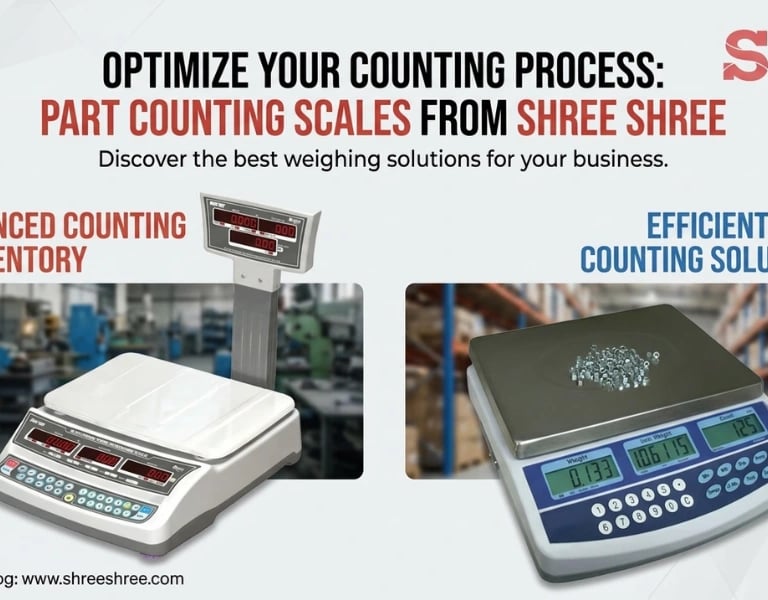
That same task now takes about four minutes, done by one person, using a piece counting scale that weighs a sample, calculates the average piece weight, and then counts out exact quantities by weight rather than by hand. The story is not unusual it plays out daily across manufacturing units, hardware distributors, jewellery workshops, and packaging operations wherever small identical items need to be counted in volume.
This guide walks through what actually matters when choosing a piece counting electronic weighing scale what makes the technology work, which specifications genuinely affect counting accuracy, and how to match the right scale to your specific components and volumes.
How a Piece Counting Scale Actually Works
The principle behind a piece counting scale is straightforward once explained, even though the technology inside the unit is doing something fairly clever. The operator places a known quantity of the item to be counted a sample, say 10 or 20 pieces onto the weighing platform. The scale's internal processor divides the total sample weight by the number of pieces in that sample to calculate an average unit weight.
Once that average unit weight is established, any additional quantity placed on the scale is automatically converted into a piece count by dividing the new total weight by the established average unit weight. Add a large batch of the same component, and the display shows the calculated quantity instead of a weight in grams or kilograms.
This works extremely well for items that are reasonably uniform in weight screws, washers, small electronic components, buttons, beads, capsules, and similar small parts. It becomes less reliable as the variation between individual piece weights increases, which is the single most important thing to understand before relying on any piece counting electronic scale for a critical inventory or production task.
Why Sample Size Accuracy Matters More Than People Expect
The Mathematics behind Counting Errors
The accuracy of a piece counting scale depends heavily on how representative the initial sample is of the full batch being counted. If a sample of 10 pieces happens to include several slightly heavier or lighter items than the batch average, the calculated unit weight will be skewed, and that skew compounds as larger quantities are counted using that flawed reference weight.
A larger sample size reduces this risk significantly. Counting a reference sample of 50 or 100 pieces, rather than just 10, produces an average unit weight that is far more representative of the true population, particularly for components with any natural variation in size or material density. Many higher-specification Unit Counting Scale allow the operator to increase the reference sample size specifically for this reason, and the better units will recalculate and refine the average weight as more pieces are added during the counting process itself, continuously improving accuracy rather than locking in the first sample reading.
Readability and Resolution
The readability of the scale the smallest increment of weight it can register directly affects how small an individual piece weight can be before counting accuracy breaks down. A piece counting electronic weighing scale with 0.1 gram readability struggles to count items that weigh a fraction of a gram each, because the resolution of the instrument simply cannot distinguish the weight differences involved with any confidence.
For very light components small electronic parts, pharmaceutical capsules, tiny hardware items a counting scale with finer readability, often down to 0.01 gram or better, becomes necessary. For heavier items like larger washers, bolts, or packaged units, a coarser readability is entirely adequate and often preferable, since it usually comes paired with a higher overall capacity.
Matching Capacity and Platform Size to Your Actual Components
Maximum Capacity Versus Practical Working Range
Every Unit Counting Scale has a maximum weight capacity, but the practical working range for accurate counting is usually well below that maximum. A scale rated for 30 kilograms capacity might count accurately and reliably up to 20 kilograms of small components before larger sample sizes and longer settling times become necessary to maintain confidence in the count.
When evaluating a counting scale for purchase, ask specifically about the recommended working range for piece counting applications, not just the stated maximum capacity. A supplier who understands the difference will give a direct answer. One who simply repeats the maximum capacity figure from the specification sheet may not have considered how the unit performs specifically for counting tasks versus straightforward weighing.
Platform Size for Your Component Type
The physical platform size needs to comfortably accommodate the container or tray holding your components, with room to add and remove items without spilling or disturbing the reading. For small components counted directly into shallow trays, a compact platform works fine. For larger items, or for operations counting directly into bins or boxes, a wider platform with sufficient clearance becomes important for practical daily use.
Key Features Worth Paying For
Tare Function and Container Weight Management
Counting almost always involves a container a tray, a bag, a small parts bin. The tare function allows the scale to subtract the weight of that container automatically, so the count reflects only the components inside it rather than being thrown off by the container's own weight. This is a basic feature on virtually every piece counting electronic scale, but it is worth confirming that the tare function is quick and intuitive to use, since it gets used constantly throughout a working day.
Hold Function for Unstable Readings
Components that settle unevenly, or counting tasks performed in environments with mild vibration, benefit from a hold function that locks the displayed count once the reading stabilises, preventing the display from fluctuating as the operator reads it. This sounds like a small detail until it is missing, at which point it becomes a genuine daily frustration.
Memory and Multiple Item Storage
The weighing area should be kept at a stable temperature, ideally between 18°C and 26°C, and away from direct sunlight, air conditioning vents, and open windows. Humidity below 45% increases static charge problems; above 70%, moisture absorption by hygroscopic samples becomes a measurement error in itself. A simple temperature-humidity logger placed near the balance gives you data to correlate against any unexplained reading anomalies.
Connectivity for Inventory Integration
For larger operations, a piece counting electronic weighing scale with USB, RS232, or Bluetooth connectivity allows count data to be logged directly into inventory management or production tracking software, removing the need for manual data entry and reducing the chance of transcription errors when counts are recorded by hand.
Matching the Scale to Your Industry
Connectivity for Inventory Integration
Electronics assembly, hardware manufacturing, and general production environments typically need a piece counting scale with fine readability for small components, reliable memory storage for multiple part types, and ideally connectivity for integration with production tracking systems. Speed and consistency across a full shift matter more here than in lower-volume settings.
Jewellery and Precious Items
Counting small precious components beads, clasps, findings demands very fine readability, since individual piece weights can be extremely small and the cost implications of inaccurate counts are higher relative to the item value. A draft shield and stable, vibration-resistant construction matter more in this setting than in general industrial counting.
Packaging and Distribution
Operations counting finished packaged units, retail components, or bulk hardware for distribution generally need higher overall capacity and a larger platform, since the items being counted are often bulkier than precision manufacturing components. Readability requirements are typically more relaxed, but throughput speed and ease of use across a busy packing line become the priority.
Pharmaceutical and Capsule Counting
Capsule and tablet counting for pharmaceutical packaging demands both fine readability and rigorous consistency, since regulatory requirements around accurate counts in pharmaceutical contexts are considerably stricter than in general retail or manufacturing settings. A counting scale used in this context should have documented calibration procedures and, depending on the regulatory environment, may need to meet specific compliance standards beyond standard commercial counting accuracy.
What to Ask Before You Buy
Before committing to any piece counting scale, confirm the recommended sample size for your specific component weight range, ask whether the unit recalculates and refines accuracy as larger quantities are added during counting, and check the readability against the actual weight of your lightest component to make sure the resolution is genuinely adequate rather than borderline.
Ask about memory capacity for storing multiple component reference weights if your operation counts more than one item type regularly, and confirm what connectivity options exist if integration with inventory software is part of your plan, even if not an immediate requirement. A scale bought without connectivity that later needs to feed data into a warehouse management system becomes an expensive limitation discovered too late.
The right piece counting electronic weighing scale earns its place in a business the same way that small electronics unit in Pune found out not through a dramatic transformation, but through a quiet, daily removal of a task that used to take far longer and produce far more errors than anyone wanted to admit.
Match the readability and sample size capability to your smallest and most variable components, confirm the working capacity suits your actual batch sizes rather than just the maximum rating on the spec sheet, and choose features like memory storage and connectivity based on how your operation will actually use the scale day to day. Get those three things right, and the counting scale becomes one of those pieces of equipment nobody thinks about anymore, simply because it works.