
Manual vs Automatic Cash Counting Machine Which Is Better?
Every business that handles cash faces the same daily reality notes need to be counted, verified, and matched. Whether it is a small retail shop counting the till at closing time or a bank branch processing hundreds of transactions before noon, the method used to count that cash has a direct impact on accuracy, speed, and the time your staff spends on a task that should be routine.
6/15/20266 min read
Every business that handles cash faces the same daily reality notes need to be counted, verified, and matched. Whether it is a small retail shop counting the till at closing time or a bank branch processing hundreds of transactions before noon, the method used to count that cash has a direct impact on accuracy, speed, and the time your staff spends on a task that should be routine.
The choice between a manual approach and an automatic cash counting machine is one that more businesses are thinking seriously about. The growth of automated note-counting technology has made it genuinely accessible not just for large financial institutions but for petrol pumps, grocery stores, pharmacies, and any operation where cash passes through regularly.
This guide lays out the honest comparison between manual counting and machine counting, covers what each option actually costs your business in time and accuracy, and helps you figure out which approach makes sense for your specific situation.
What Manual Cash Counting Actually Involves
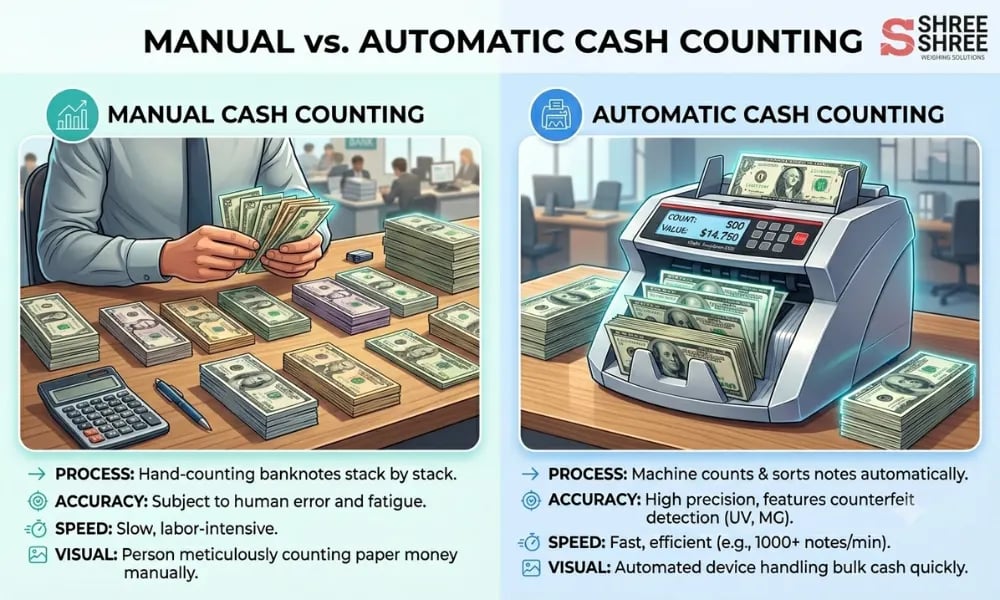
Manual cash counting is exactly what it sounds like a person, a flat surface, and a stack of notes. The counter sorts notes by denomination, counts each bundle, and records the total. In businesses with modest cash volumes and experienced staff, this works well enough. The process is familiar, requires no equipment, and gives the counter a physical feel for whether the notes are genuine.
The problem with manual counting shows up the moment volume increases or fatigue sets in. A person counting five hundred notes at the end of a twelve-hour shift makes more errors than the same person counting fifty notes mid-morning. The concentration required for accurate manual counting degrades with repetition in a way that no amount of training fully addresses.
There is also the matter of fake note detection. A trained cashier can feel a suspicious note and flag it but that tactile skill takes years to develop and is inconsistent under pressure. Manual counting offers no systematic protection against counterfeit currency passing through undetected.
For very low-volume cash environments a small café, a single-person office managing occasional cash receipts manual counting is entirely adequate. The moment the volume grows beyond what one person can manage confidently in under ten minutes, the case for automation starts to build.
How an Automatic Cash Counting Machine Works
An automatic currency counting machine feeds a stack of notes through a mechanical path at speed, counting each one as it passes a sensor. Entry-level models count notes of a single denomination at rates of 800 to 1,000 notes per minute. Mid-range and high-specification machines count mixed denominations, detect fake notes through UV, MG, and IR sensor combinations, and display a running total on a screen as counting progresses.
The hopper where notes are loaded and the stacker where counted notes are collected are the two main physical components that affect usability. A larger hopper capacity means fewer interruptions during high-volume counting sessions. A stacker that keeps notes neatly arranged saves the time that would otherwise be spent re-organising counted bundles before banking.
Modern machines also offer a batch function, which stops counting and alerts the operator once a preset number of notes have been counted. For businesses that prepare cash bundles in fixed quantities 50 or 100 notes for banking or float preparation, this feature alone saves a meaningful amount of time per session.
The error detection built into a quality currency counting machine is where the technology genuinely earns its place. UV sensors detect fluorescent markings that genuine currency carries and counterfeit notes typically lack. MG sensors check for the magnetic ink used in legitimate currency printing. IR sensors assess light transmission patterns through the note. Together, these create a layer of fake note detection that no manual process can consistently replicate.
Speed and Accuracy The Numbers That Matter
The accuracy argument for automatic counting is straightforward: machines do not get tired. A currency counting machine set to count 100 notes counts exactly 100 notes, every session, without variation caused by fatigue, distraction, or the pressure of a queue forming at the counter.
The Human Error Cost
Research across retail and banking environments consistently shows that human counting error rates double-counts, missed notes, transposition errors during recording run between 0.5% and 2% under normal conditions and higher under stress. On a daily cash intake of ₹2,00,000, a 1% error rate represents a ₹2,000 discrepancy that either costs the business directly or takes significant time to trace and resolve.
Over a month, these small errors accumulate. Over a year, they represent a genuinely meaningful financial leakage and that is before accounting for the staff time spent re-counting, reconciling, and investigating shortfalls.
Machine Counting Accuracy
A properly maintained automatic cash counting machine operates at effectively zero counting error when notes are in reasonable condition and loaded correctly. The machine does not count a note twice, does not skip a note in a bundle, and does not misread a denomination if the appropriate denomination-recognition technology is installed. The accuracy gap between human and machine counting is not marginal it is the difference between systematic reliability and variable performance.
Cost Comparison What You Are Actually Paying For
The upfront cost of a basic currency counting machine in India starts at around ₹5,000 to ₹8,000 for an entry-level single-denomination counter. Mid-range mixed-denomination machines with full UV, MG, and IR detection run from ₹15,000 to ₹40,000. High-specification machines used in banking environments can go higher, but those specifications are rarely necessary outside financial institutions.
Manual counting has no equipment cost, which is why it appears cheaper at first glance. The actual cost calculation looks different when you factor in staff time. A cashier spending forty minutes per day on manual cash counting and reconciliation a conservative estimate for a busy retail environment represents over 240 hours per year dedicated to a process that a machine would complete in under five minutes.
At an average wage cost, that staff time has a real financial value. The machine pays for itself not against a zero baseline but against the ongoing cost of the time it replaces. For most businesses handling daily cash volumes above ₹50,000, the payback period on a mid-range machine is measured in weeks rather than years.
There is also the cost of errors to factor in. A single undetected counterfeit note accepted through manual checking costs the business the full face value of that note. A machine with proper fake note detection eliminates this exposure across every session it operates.
Cost Comparison What You Are Actually Paying For
When Manual Counting Is Sufficient
Manual counting remains appropriate for businesses with very low daily cash volumes typically fewer than 100 notes per day where the time investment is genuinely small and the risk of counterfeit exposure is limited. Home-based businesses, small service providers who receive occasional cash payments, and operations where cash handling is truly incidental rather than core to the daily workflow can function adequately without a machine.
When an Automatic Machine Makes Sense
Any business where cash counting takes more than fifteen minutes per day has a strong case for automation. Retail shops with active footfall, petrol stations, pharmacies, restaurants, supermarkets, money exchange businesses, and any operation that prepares regular cash deposits will find that the time saving alone justifies the investment within the first few months.
Banks and financial institutions operate at a different scale entirely. For these environments, a basic cash counting machine is not appropriate the volume demands dedicated currency sorting machines with full denomination recognition, advanced counterfeit detection, and the ability to handle worn or soiled notes without jamming. The machine category is the same, but the specification requirement is significantly higher.
Hotels, event venues, and businesses with variable but occasionally high cash volumes sit in the middle. A mid-range machine handles peak periods efficiently without the investment required for permanent high-volume infrastructure.
The Fake Note Problem Where the Decision Often Gets Made
For many businesses, the fake note detection capability of an automatic currency counting machine is the deciding factor not the speed, not the cost calculation, but the protection it provides against accepting counterfeit currency.
Counterfeit notes in Indian circulation are not a theoretical risk. The Reserve Bank of India reports detected fake notes annually, and the figures consistently show that ₹100, ₹200, ₹500, and ₹2,000 denominations are the most counterfeited. A business accepting cash in these denominations without machine-based verification is relying entirely on the training and attention of its staff a standard that varies and degrades.
A cash counting machine with UV, MG, and IR detection does not have off days. It applies the same detection standard to every note, every time, regardless of how busy the counter is or how long the operator has been on shift. For businesses in high-footfall retail, hospitality, or transport, this consistency has genuine commercial value.
The manual versus automatic debate has a reasonably clear answer for most businesses: if cash is a meaningful part of your daily operation, a cash counting machine is not a luxury it is a sensible operational tool that pays for itself through time saving, error reduction, and counterfeit protection.
The real decision is not whether to automate but which specification of currency counting machine matches your actual volume and risk profile. A ₹5,000 basic counter is not the right answer for a bank branch, and a ₹40,000 multi-denomination sorter is overkill for a neighbourhood pharmacy. Matching the machine to the operation is where the value comes from.
Start by calculating your actual daily counting time, your average cash volume, and the denomination mix you handle most frequently. Those three numbers will tell you exactly what specification you need and what it will cost you to keep counting by hand.