
Laboratory Weighing Scale Buying Guide 10 Things Every Lab Manager Must Check before Purchasing
Buying a laboratory weighing scale sounds straightforward until you are standing in front of a supplier's catalogue with forty-seven models, three different accuracy classes, and a price range that spans from affordable to eye-watering. The wrong choice does not just waste budget it compromises experimental results, fails regulatory audits, and creates daily frustration for the people actually using the instrument.
6/3/20266 min read
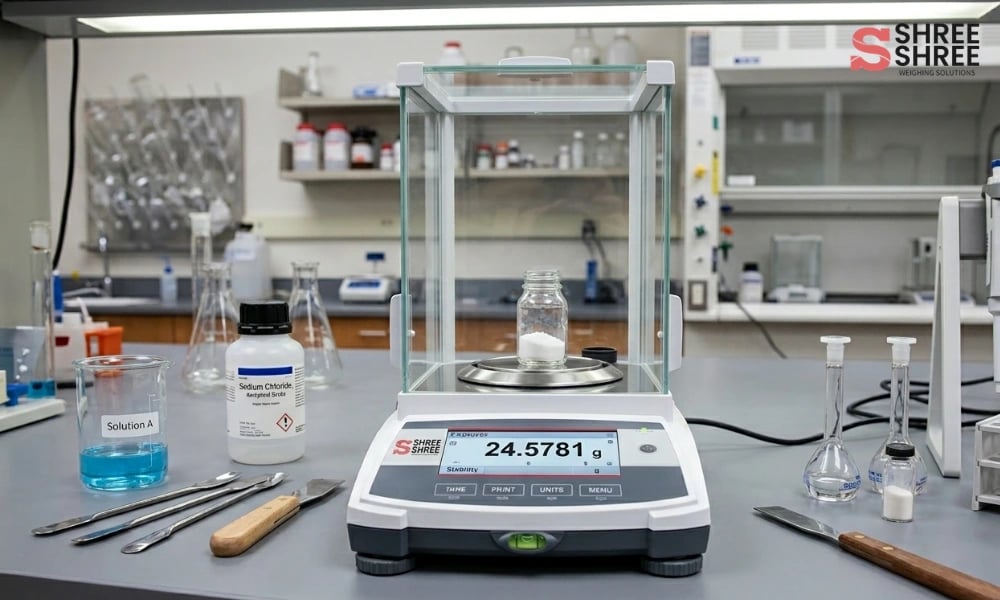
This guide covers the ten things that genuinely matter when selecting a laboratory weighing machine. Not the obvious stuff every manufacturer brochure mentions, but the practical considerations that experienced lab managers learn through expensive trial and error. Whether you are equipping a new pharmaceutical research lab, upgrading an existing quality control setup, or purchasing for an academic institution, these checkpoints will save you from the most common and most avoidable purchasing mistakes.
1. Readability Is Not the Same as Accuracy
The first number most buyers look at on a laboratory weighing scale specification sheet is the readability how small a unit of weight the display can show. A scale with 0.0001g readability looks impressive. But readability alone tells you almost nothing about how accurate the instrument actually is.
The number you should be looking at alongside readability is repeatability also called standard deviation. This tells you how consistently the scale gives the same result when you weigh the same sample multiple times under identical conditions. A balance that displays results to four decimal places but gives a different reading each time is performing worse than a balance with lower readability that delivers consistent, repeatable results.
Ask every supplier for the repeatability specification, not just the readability. For a digital laboratory weighing scale used in analytical work, repeatability of 0.1mg or better is typically required.
2. Capacity versus Precision the Trade-Off Every Buyer Must Understand
Higher capacity almost always means lower precision. This is a fundamental engineering reality, not a quality compromise. A balance capable of weighing up to 5kg will not deliver the same sensitivity as one with a 200g maximum capacity. They are designed for different jobs.
Before specifying any laboratory weighing machine, map out the actual weight range of samples your lab works with. If you regularly weigh samples between 1g and 100g, a balance with a 200g capacity and 0.1mg readability is likely the right fit. If your lab handles both milligram-range reagents and kilogram-scale bulk materials, you may need two instruments rather than one compromise model that does neither job well.
Never buy more capacity than your application genuinely requires. You pay for it in lost sensitivity.
3. The Environment Your Scale Will Live In
A laboratory weighing scale performs very differently on a stable granite bench in a temperature-controlled room versus on a vibrating workbench near an HVAC unit and a fume hood with variable airflow. The instrument's specifications reflect ideal laboratory conditions. Your actual conditions may be considerably less ideal.
Check whether the balance offers built-in vibration compensation and draft shield protection. For any analytical balance where readings extend to four or more decimal places, a well-designed draft shield is not optional even gentle air movement from a nearby person walking past can affect the reading. Some modern balances include automatic environmental compensation that adjusts for minor vibrations and temperature fluctuations internally.
If your lab environment is particularly challenging high humidity, chemical vapour exposure, or significant vibration from nearby machinery discuss this specifically with the supplier before selecting a model.
4. Internal Calibration vs External Calibration
What the Difference Actually Means Day to Day
A balance with internal calibration contains a built-in reference weight. At the press of a button or automatically at set intervals the balance calibrates itself against this internal standard. No external weights needed, no manual process, no risk of the calibration weight being misplaced or contaminated.
External calibration requires you to place certified reference weights on the pan manually and follow a calibration procedure. The balance relies entirely on the quality and traceability of the weights you use and the consistency of the person performing the calibration.
Which Should You Choose
For regulated laboratory environments pharmaceutical, food testing, clinical internal calibration is strongly preferred. It creates a consistent, documented calibration record without human variables entering the process. For research labs with more flexible workflows and tighter budgets, external calibration can be entirely appropriate if the calibration procedure is followed rigorously and documented properly.
The compliance requirements of your specific lab environment should drive this decision more than any other single factor.
5. GLP and GMP Documentation Output
If your laboratory operates under Good Laboratory Practice or Good Manufacturing Practice guidelines as most pharmaceutical, contract research, and food safety labs do the weighing records your balance produces are part of your regulatory compliance documentation.
A laboratory weighing scale intended for GLP or GMP environments needs to output data that meets documentation requirements: date and time stamping, user identification, sample identification fields, statistical analysis of repeated measurements, and ideally direct connectivity to your laboratory information management system.
Before purchasing, check what data output formats the balance supports. Can it print to a connected balance printer? Does it export to USB or RS232? Does the output format meet the specific documentation standards your regulatory body requires? These are not afterthoughts they should be confirmed before the purchase order is raised.
6. Pan Size Relative to Your Typical Sample Containers
This is one of the most consistently overlooked specifications in the buying process. The weighing pan needs to comfortably accommodate the sample containers, crucibles, flasks, or boats your lab routinely uses. A 90mm diameter pan sounds adequate until you realise your standard beakers are 100mm at the base.
Measure your most commonly used sample containers and compare those dimensions against the pan size specifications of any balance you are considering. For labs working with larger containers alongside precision requirements, look for balances that offer extended pan sizes without compromising on the sensitivity specification.
7. Connectivity and Software Integration
Modern laboratory environments increasingly expect weighing data to flow directly into digital records eliminating manual transcription errors and creating a clean audit trail. A digital laboratory weighing scale that can connect to your LIMS, your ERP system, or simply export clean data files changes the daily workflow significantly.
Standard connectivity options include RS232 serial ports (still widely used in laboratory equipment), USB, and Ethernet. Bluetooth connectivity is available on some models but is less common in analytical applications where wired connections provide more reliable data transmission.
Check whether the balance manufacturer provides software for data capture and management, and whether that software integrates with systems already in use in your institution. The cost of the balance is only part of the total cost integration time and software licensing should be factored into any honest comparison.
8. After-Sales Support and Calibration Service Availability
A laboratory weighing machine that cannot be serviced or recalibrated locally is a liability regardless of how impressive its specifications are. Annual calibration by an accredited service provider is a requirement in most regulated lab environments and in many unregulated ones as well, simply as a matter of good practice.
Before committing to any brand or supplier, find out who provides calibration services for that instrument in your area. Are traceable calibration certificates traceable to national or international standards available from the service provider? How long does a typical service visit take, and what is the instrument's expected turnaround time if it needs to go in for repair?
The best specification on paper means nothing if the balance sits unused for six weeks waiting for a service engineer.
9. IP Rating and Chemical Resistance for Your Specific Lab
Not every laboratory is a clean, dry, dust-free environment. Weighing scales used in chemical manufacturing quality control, environmental testing, or food production laboratories are regularly exposed to moisture, cleaning agents, and chemical splashes.
Standard analytical balances are not designed for wet environments. For applications involving water, aggressive cleaning protocols, or chemical exposure, look for balances with appropriate IP (Ingress Protection) ratings IP54 at minimum for splash resistance, higher for more demanding environments. Stainless steel pans and chemical-resistant housing materials should be standard in these settings.
Specifying a balance without considering the cleaning and exposure requirements of its environment is one of the more expensive mistakes a lab manager can make, because the damage often shows up gradually rather than immediately.
10. Total Cost of Ownership Not Just the Purchase Price
The purchase price of a laboratory weighing scale is the starting point, not the full picture. The true cost over a five-year period includes: annual calibration and service, replacement parts such as pans and draft shields, consumables like calibration weights if using external calibration, software licensing if applicable, and the cost of downtime when the instrument is unavailable.
A balance priced 30% lower than a competitor may cost significantly more over five years if its calibration service is expensive, its parts are difficult to source, or it has a higher incidence of drift requiring more frequent recalibration. Ask suppliers for total cost of ownership estimates based on your expected usage patterns any serious supplier should be able to provide this.
Purchasing decisions made purely on initial price almost always look less attractive three years into the instrument's working life.
The right laboratory weighing scale for your lab is not necessarily the most expensive one, the most precise one, or the one from the most recognisable brand. It is the one that matches your actual application requirements, performs consistently in your specific environment, integrates cleanly into your documentation workflow, and can be serviced and calibrated reliably throughout its working life.
Take these ten checkpoints into every supplier conversation and every specification review. The purchasing decision you make today will affect the quality of your lab's work and the confidence of everyone relying on that data for years to come.