
How Plastic Platform Trolleys Are Manufactured From Mould Design to Finished Product
Discover how a plastic platform trolley manufacturer creates products from mould design to finished trolley a behind-the-scenes guide for buyers and procurement teams.
6/2/20266 min read
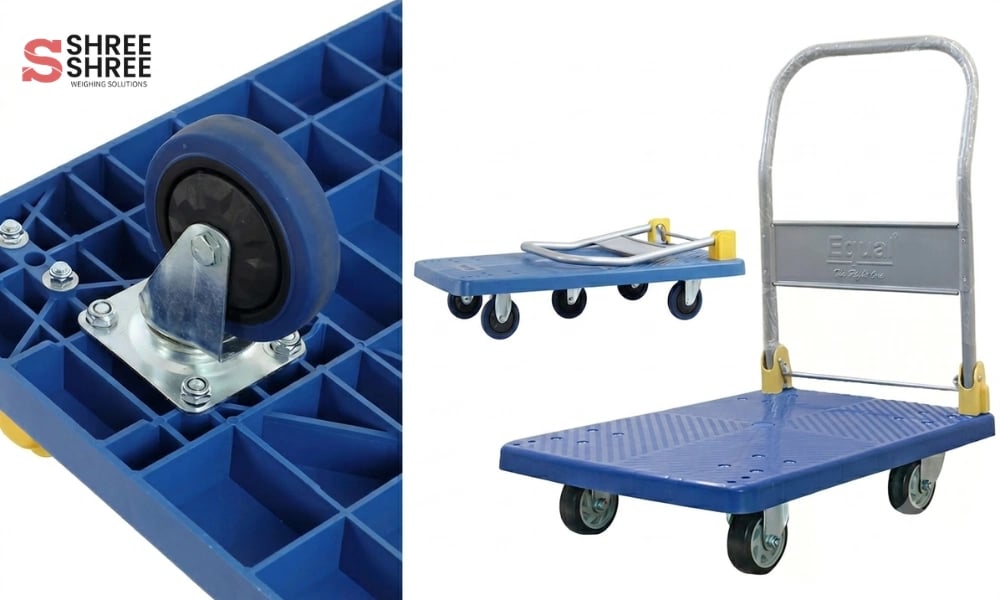
Understanding how plastic platform trolleys are made gives buyers a meaningful advantage. It changes the questions you ask a supplier, the specifications you prioritise, and the way you evaluate competing quotations. A plastic platform trolley manufacturer who can walk you clearly through their production process is almost always more credible than one who cannot and this guide explains exactly why.
It Starts Long Before the First Piece of Plastic Is Melted
The manufacturing process for a plastic platform trolley begins not on the production floor but in the engineering office. Before a single kilogram of raw material is processed, the manufacturer must define what the trolley needs to do its load capacity, its dimensions, the environments it will operate in, the floor surfaces it will move across, and the frequency and intensity of daily use it must withstand.
These requirements feed directly into the structural design. The deck thickness, the rib pattern underneath the platform, the wall thickness of the side panels, and the geometry of the castor mounting points are all calculated against the expected load and stress patterns. A trolley designed to carry 300 kilograms of evenly distributed goods on a smooth warehouse floor is engineered differently from one that will carry the same weight across uneven factory flooring or will be loaded unevenly with bulky items that concentrate stress at specific points.
This engineering work is what separates a considered product from a commodity moulding. Buyers sourcing from a supplier who simply replicates an existing mould without understanding the engineering behind it have no way of knowing whether that design is adequate for their specific application.
Raw Material Selection The Decision That Defines Long-Term Performance
Why Plastic Grade Matters More Than Most Buyers Realise
The most common materials used in platform trolley manufacturing are High-Density Polyethylene (HDPE) and Polypropylene (PP). Both are thermoplastics that can be injection moulded or blow moulded into complex shapes, but they behave differently under load, at temperature extremes, and in the presence of chemicals and UV exposure.
HDPE has excellent impact resistance and performs well at low temperatures without becoming brittle. It is the preferred material for trolleys that will be used in cold storage environments or outdoor applications where temperature variation is significant. Its surface is relatively smooth, which makes cleaning straightforward a meaningful advantage in food industry and healthcare applications.
Polypropylene offers higher rigidity than HDPE at the same wall thickness, which can allow for slightly thinner mouldings without sacrificing structural integrity. It also has better fatigue resistance under repeated flexing loads relevant for trolley decks that experience dynamic loading as goods are placed and removed repeatedly through the working day.
Virgin Resin vs Recycled Material
A decision that affects both quality and cost is whether the manufacturer uses virgin resin, recycled material, or a blend of both. Virgin resin delivers consistent mechanical properties and predictable performance. Recycled material varies in quality depending on its source and processing some recycled HDPE is entirely appropriate for lower-specification applications, while poor-quality recycled content can produce trolleys that crack under load or degrade rapidly under UV exposure.
A responsible plastic platform trolley manufacturer will be transparent about the material specification they use and will provide material data sheets on request. A supplier who is evasive about material composition is worth treating with caution, particularly for applications where trolley failure carries safety implications.
Mould Design and Tooling Where Product Quality Is Locked In
The mould is the most significant capital investment in plastic trolley manufacturing. A well-designed, precision-machined mould produces parts with consistent wall thickness, accurate dimensions, and clean surface finish across thousands of production cycles. A poorly designed or worn mould produces parts with sink marks, warping, inconsistent dimensions, and surface defects that weaken the finished product.
Mould design for a plastic platform trolley involves decisions about gate location where the molten plastic enters the mould cavity runner design, cooling channel placement, and ejector pin positioning. Each of these affects how the plastic flows and solidifies within the mould, which in turn affects the mechanical properties of the finished part.
The rib structure on the underside of the trolley deck is a particular area where mould design quality is visible. These ribs are not decorative they are structural elements that transfer load from the deck surface down to the castor mounting points. A mould that produces ribs with consistent thickness and sharp internal radii delivers a structurally sound product. A mould with worn or poorly designed rib geometry produces ribs that are weaker than the design specifies.
When evaluating a plastic platform trolley supplier, it is entirely reasonable to ask about the age and condition of their production tooling, and whether they manufacture their moulds in-house or source them externally. In-house tooling capability generally means faster response to design changes and better control over dimensional consistency.
The Injection Moulding Process Turning Raw Material Into Structure
With material selected and tooling in place, the production process begins with the injection moulding machine. Raw plastic granules are fed into a heated barrel where they are melted and mixed to a consistent viscosity. The molten plastic is then injected under high pressure into the mould cavity, where it fills every section of the tool the deck surface, the ribs, the sidewalls, and the castor pockets before being held under pressure while it cools and solidifies.
The injection parameters melt temperature, injection pressure, holding pressure, cooling time, and ejection timing must be carefully controlled for each specific mould and material combination. Variations in any of these parameters produce variations in the finished part. This is why process control documentation matters in a well-run manufacturing operation: the settings that produced a good part today should be recorded and reproduced precisely tomorrow, next week, and next month.
Once the main deck and structural components are moulded, they are trimmed of any flash thin excess plastic at the parting line of the mould and inspected for dimensional accuracy and surface quality before moving to the assembly stage.
Assembly, Castor Fitting and Quality Inspection
The deck moulding alone is not a finished trolley. Assembly involves fitting the castor wheels, attaching handles where the design includes them, and in some cases assembling multiple moulded components such as fold-down sides or removable shelves into the complete product.
Castor Selection and Fitting
The castor wheels are arguably the component that most directly affects the daily user experience of a plastic platform trolley. Wheel diameter determines how easily the trolley rolls over floor joints, thresholds, and surface irregularities. Wheel material polyurethane, nylon, rubber determines noise level, floor marking, load capacity, and chemical resistance. Swivel castors provide manoeuvrability; fixed castors provide directional stability. The right combination depends on the specific application.
A quality plastic platform trolley manufacturer sources castors that are matched to the load rating and application of the trolley not simply the lowest-cost wheel that fits the mounting pocket. Castor failure is one of the most common reasons trolleys are taken out of service prematurely, and it almost always traces back to under-specification at the design or sourcing stage.
Final Inspection and Load Testing
Before a trolley leaves the production facility, a final inspection should verify dimensional accuracy, surface quality, castor function, and structural integrity. Reputable manufacturers conduct periodic load testing placing the rated capacity on finished trolleys and confirming that the structure performs without deflection, cracking, or castor failure.
For buyers placing significant volume orders, requesting a production quality report or a batch inspection certificate from the manufacturer is entirely standard practice. A plastic platform trolley supplier confident in their production quality will accommodate this without hesitation.
What the Manufacturing Process Tells You About Supplier Quality
The reason this behind-the-scenes understanding matters to buyers is straightforward. Two trolleys sitting side by side on a supplier's showroom floor can look virtually identical and carry the same load rating label, while being separated by a significant quality gap that only reveals itself under the conditions of actual industrial use.
The manufacturer who uses virgin resin to specification, maintains precision tooling, controls injection parameters rigorously, and fits appropriately rated castors produces a trolley that performs as labelled across its full working life. The manufacturer who cuts corners on material grade, runs tooling past its useful life, and fits the cheapest available castors produces a trolley that looks adequate on day one and causes operational problems within a year.
Asking a potential plastic platform trolley manufacturer to walk you through their production process material specification, tooling age, process controls, inspection procedures is one of the most effective ways to separate genuine manufacturing capability from a polished sales presentation.
The manufacturing process behind a plastic platform trolley is more considered than most buyers ever think about and understanding it changes how you evaluate suppliers and compare products. The quality decisions made at the design stage, in raw material selection, in mould engineering, and in production process control are not visible in a product photograph or a brochure specification. They show up in how the trolley performs under daily load, in how long it maintains its structural integrity, and in whether your fleet needs replacing in two years or ten.
The next time you are sourcing plastic trolleys for your operation, treat the manufacturing conversation as part of the procurement process not an afterthought. The supplier who welcomes those questions is the one worth working with.