
Industrial Heavy Duty Weighing Scale Manufacturer India Complete Buyer's Guide
Every tonne misweighed in a warehouse, every overloaded truck waved through without verification, every production batch dispatched without accurate weight documentation these are not just operational slip-ups. They are financial losses, compliance failures, and in many industries, genuine safety risks.
6/3/20266 min read
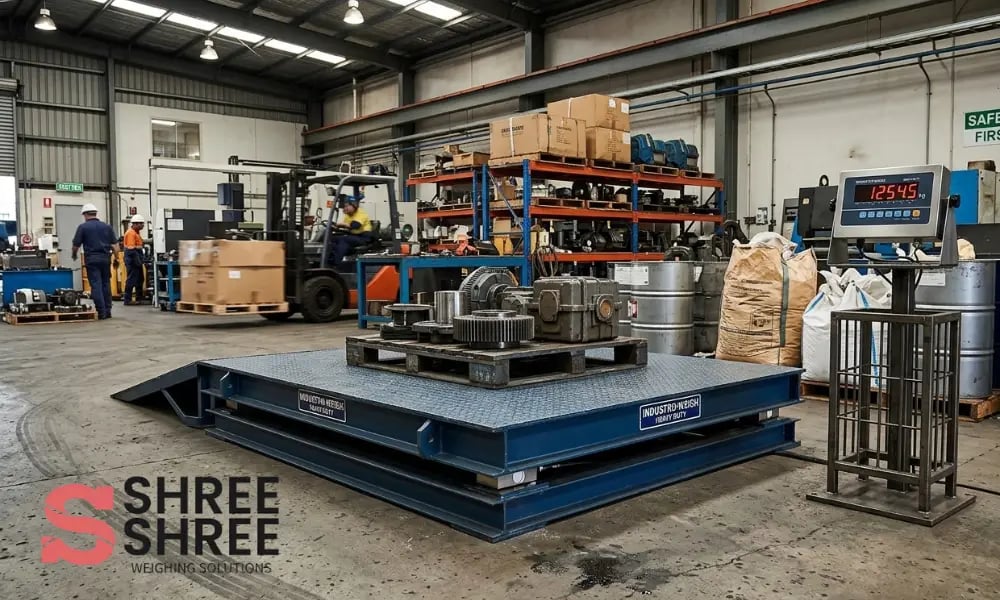
Heavy duty weighing scales are the instruments that prevent all of this from happening. They sit at the heart of logistics operations, manufacturing plants, steel yards, cement factories, agricultural mandis, and dozens of other industries where accurate measurement of large loads is a daily requirement. And the quality of that measurement depends entirely on who built the scale and how well it was made.
India has a large and well-developed industrial scale manufacturing sector. Choosing the right heavy duty weighing scale manufacturer in India is not complicated once you know what to look for but it does require asking the right questions before any purchase decision is made. This guide walks through everything a serious industrial buyer needs to evaluate.
Why the Manufacturer Matters More Than the Model
Many buyers focus on finding the right model of scale the right capacity, the right platform size, the right display. All of that matters. But the manufacturer behind the product determines whether those specifications hold up in the real world, whether the instrument drifts out of calibration under continuous use, whether spare parts are available when something needs replacing, and whether the warranty is backed by genuine after-sales support.
An industrial scale manufacturer with proper engineering capability designs the load cells, the structural frame, and the electronics to work as an integrated system. A manufacturer who assembles components sourced from multiple suppliers with no in-house engineering oversight produces a scale that may perform adequately in test conditions but degrades faster under the continuous mechanical stress of genuine industrial use.
The distinction matters enormously over a five-year operational horizon. A scale from a well-established manufacturer, properly maintained, will deliver consistent accuracy across thousands of weighing cycles. A cheaper alternative from an unverified source may save money on day one and cost considerably more by year two.
Types of Heavy Duty Industrial Scales
What the Difference Actually Means Day to Day
Platform scales are the workhorse of heavy industrial weighing. They sit at floor level, accept loads placed directly on the weighing surface, and are available in capacities from a few hundred kilograms up to several tonnes. For warehouses, dispatch areas, and production floors where goods are moved by forklift or pallet truck, a low-profile platform scale with a wide weighing surface is typically the correct choice.
Floor scales designed for industrial environments are built with structural steel frames, high-capacity load cells positioned at each corner of the platform, and indicator units that can be mounted at a convenient height for the operator. The best industrial scale manufacturers design these with practical use in mind non-slip surfaces, easy-clean designs, and cable management that keeps trip hazards away from busy working areas.
Pit Mounted Weighbridges
A weighbridge also called a truck scale is the large-format version of industrial weighing, designed to measure the weight of fully loaded vehicles. They are installed in a pit at ground level so that vehicles can drive directly onto the weighing surface without ramps. Weighbridges are standard infrastructure at quarries, ports, grain procurement centres, waste management facilities, and any industrial site where incoming or outgoing goods are transported by vehicle.
The capacity range for weighbridges typically starts at 30 tonnes and goes up to 150 tonnes or more for heavy mining or port applications. The structural engineering involved in a weighbridge installation is significantly more complex than a standard platform scale, which is why manufacturer selection here is particularly critical.
Crane Scales and Hanging Scales
For loads that cannot be placed on a platform long steel sections, suspended machinery components, large tanks or containers crane scales provide the solution. The load hangs from the scale, which itself is attached to a crane hook or overhead lifting system. Capacity ranges from a few hundred kilograms to several hundred tonnes for heavy industrial lifting applications.
A reliable heavy scale supplier offering crane scales should be able to provide load testing certificates and confirm that the shackles and attachment points are rated to the appropriate safety factor above the stated weighing capacity.
Axle Weighers and Weigh-in-Motion Systems
Axle weighers measure the weight of individual vehicle axles rather than the total gross vehicle weight. They are used at highway checkpoints, within ports, and at industrial sites where axle load compliance is a regulatory requirement. Weigh-in-motion systems take this further, measuring axle loads while the vehicle moves at low speed significantly increasing throughput compared to static weighing.
Key Technical Specifications to Evaluate
Load Cell Quality and Configuration
The load cell is the component that actually measures weight. Everything else in a weighing system the frame, the display, the software exists to support what the load cell does. In heavy duty applications, load cells must withstand not just the rated capacity but dynamic loading from vehicles driving on, impacts from goods being dropped onto the platform, and the cumulative mechanical stress of continuous industrial use.
Ask any heavy duty weighing scale manufacturer in India about the load cell specification: the material (stainless steel or alloy steel), the IP protection rating (IP67 or IP68 for environments exposed to water and dust), the overload rating (how far above capacity the cell can safely go without permanent damage), and whether the cells carry internationally recognised certifications such as OIML or NTEP.
Indicator and Software Capability
The weight indicator is the interface between the weighing system and the people operating it. For basic industrial use, a clear digital display with simple tare and net weighing functions may be all that is needed. For more complex applications vehicle weighing with axle differentiation, integration with ERP or warehouse management systems, automated ticketing the indicator needs corresponding software capability.
Before finalising a purchase with any industrial scale manufacturer, confirm that the indicator can output data in the format your operation requires and that integration with your existing systems is technically feasible.
Legal Metrology Certification
In India, weighing instruments used for commercial transactions buying or selling goods by weight must be verified and stamped under the Legal Metrology Act. Scales used for trade that have not been through this verification process are not legally compliant, and operating non-verified trade scales carries penalties.
A credible heavy duty weighing scale manufacturer in India will either supply scales pre-verified under Legal Metrology, or will clearly advise buyers on the verification process and work with authorised verification officers to get instruments stamped post-installation. Always confirm the legal metrology status of any instrument before it is commissioned for commercial use.
How to Evaluate an Industrial Scale Manufacturer in India
Manufacturing Capability and In-House Engineering
The gap between a genuine manufacturer and an assembler is significant. A genuine industrial scale manufacturer designs and fabricates the structural components of their scales, has in-house load cell testing equipment, and employs engineers who understand the relationship between frame stiffness, load cell placement, and weighing accuracy under real-world conditions.
When evaluating a potential heavy scale supplier, ask to visit the manufacturing facility or request a detailed factory audit report. Look for evidence of in-house fabrication rather than outsourced component assembly. A manufacturer who can walk you through their engineering process load cell calibration, frame welding specifications, indicator testing before dispatch is a manufacturer who takes product quality seriously.
After-Sales Service Network
A weighbridge installed at a remote industrial site needs service support within a reasonable response time. An analytical balance in a city laboratory has more service options nearby. Wherever your scales will be installed, confirm that the manufacturer has a service network capable of responding when calibration is due or a fault develops.
Annual calibration by an accredited service provider is not optional for trade-use scales in India it is a legal requirement. Confirm that the manufacturer either provides calibration services directly or has certified service partners in your region.
Reference Installations and Client History
Any established industrial scale manufacturer should be able to provide references from clients in similar industries to yours. A manufacturer who has successfully supplied and commissioned weighbridges at multiple quarry sites carries very different credibility from one who is proposing their first installation of that type.
Ask for reference contacts and follow up on them. The questions worth asking previous clients are not just whether the scale works, but whether the installation was completed on time, whether the documentation was accurate, whether service response has been satisfactory, and whether the scale has maintained its accuracy over time.
Total Cost of Ownership The Number That Actually Matters
The purchase price of an industrial scale is the most visible number in any procurement decision, but it is rarely the most important one over a five-year horizon. Annual calibration costs, spare load cell pricing, software upgrade costs, installation costs for complex pit-mounted systems, and the cost of downtime when a scale is out of service all feed into the true cost of ownership.
A heavy scale supplier offering an attractive headline price may look less competitive once service costs, spare part availability, and calibration pricing are factored in. Conversely, a manufacturer whose initial quotation is higher may represent better long-term value through lower maintenance costs, more accessible spare parts, and a stronger service network.
Request a five-year total cost of ownership estimate from any serious supplier. A manufacturer confident in their product quality will engage with this calculation openly. One who deflects or focuses only on purchase price is telling you something important about how they expect the instrument to perform over its working life.
The Indian industrial scale manufacturing sector has genuine capability at the top end manufacturers who design properly engineered systems, support them with real after-sales infrastructure, and stand behind their products with meaningful warranties and calibration support. They exist alongside a larger number of assemblers and traders who offer lower prices and considerably less accountability.
The buyer who takes the time to verify manufacturing credentials, check legal metrology compliance, review reference installations, and calculate total cost of ownership will make a purchasing decision they are confident in two, three, and five years from now.
Your weighing infrastructure is not a line item to optimise on price alone. It is a foundational operational tool. Choose the manufacturer who has earned the right to supply it.