
Digital Weighing Scale Buying Guide What Every Buyer Must Know
Planning to buy a digital weighing scale? This complete guide covers types, features, accuracy, and what to check before purchasing for home, business, and industrial use.
5/25/20268 min read
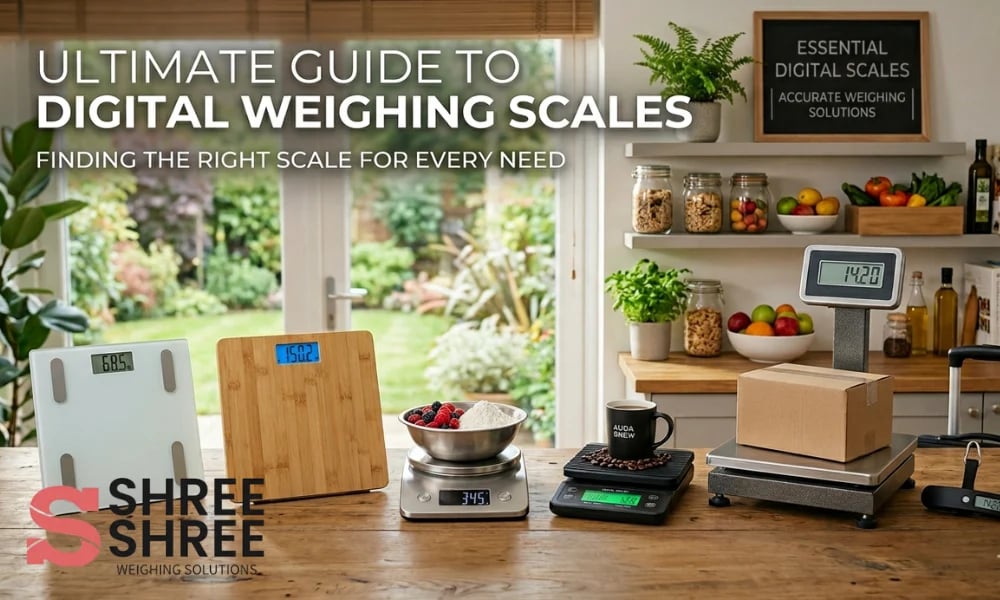
A digital weighing scale is one of those purchases that looks straight forward on the surface but has a lot of important detail underneath. Whether you're buying for your kitchen, your gym, your retail counter, your medical clinic, or your factory floor, the right scale depends entirely on what you're weighing, how often you're weighing it, and what level of precision your situation demands.
This guide is written for real buyers not engineers or industry insiders. By the time you finish reading, you'll know exactly what to look for, which features actually matter for your use case, and what mistakes to avoid when making your purchase.
Why the Type of Scale Matters More Than the Brand
Before looking at individual models or comparing prices, the most important step is identifying which category of digital weighing scale fits your actual need. Buying the wrong type even a high-quality one leads to frustration, inaccurate readings, and often an early replacement.
Here's a breakdown of the main types and where each one belongs.
Kitchen and Cooking Scales
These are compact, flat, and designed for food measurement. They typically measure in grams, kilograms, millilitres, and ounces, and their capacity ranges from 1 kg to about 10 kg. Precision is important here particularly for baking, where 5 grams too much flour can affect an entire recipe.
Key things to look for: a tare function (to zero out the weight of the bowl or container), easy-to-clean surfaces, and a clear display that's readable even in a busy kitchen.
Personal Body Weight Scales
These are the bathroom scales most people are familiar with. They measure in kilograms, pounds, or stones, and their capacity typically goes up to 150 kg or 180 kg. Modern versions often include body composition analysis measuring body fat percentage, muscle mass, bone density, and hydration levels using bioelectrical impedance technology.
For personal use, accuracy within 100 grams is generally acceptable. For clinical or fitness tracking purposes, more precision is worth investing in.
Retail and Commercial Scales
Used in shops, markets, delis, and food service environments, these scales are designed to weigh goods for sale. They often include a price computing function you enter the price per kilogram, place the item on the platform, and the scale calculates the total cost automatically.
Commercial scales used for trade (meaning the weight is used to determine the price paid by a customer) must be legally verified and approved by the relevant weights and measures authority in your country. This is a non-negotiable requirement that many buyers overlook.
Jewellery and Precision Scales
When you're measuring gold, gemstones, pharmaceuticals, or any material where even a fraction of a gram matters, standard scales simply won't do. Precision scales measure in units as small as 0.001 grams (1 milligram) and are essential in industries where tiny differences in weight have significant financial or safety implications.
These scales are sensitive and need to be used on a stable, vibration-free surface, away from drafts and air conditioning vents.
Industrial and Heavy-Duty Platform Scales
At the other end of the spectrum, industrial digital weighing scales handle loads that could reach hundreds or even thousands of kilograms. Platform scales, floor scales, pallet scales, and crane scales all fall into this category. They're used in warehouses, manufacturing plants, agriculture, logistics, and anywhere that large, heavy items need to be weighed efficiently.
Durability, waterproofing, and structural load capacity are the priority features here. These scales need to function reliably in demanding environments dust, moisture, mechanical vibration, and heavy continuous use.
Laboratory Scales and Analytical Balances
Used in scientific research, quality control, and pharmaceutical manufacturing, laboratory scales require extreme precision and are built to operate in controlled environments. They're calibrated regularly, protected from environmental interference, and designed to produce readings that are repeatable and documentable.
The Features That Actually Matter
Once you've identified the right type for your situation, the next step is evaluating features. Here's an honest look at what's genuinely useful and what's just noise.
Readability and Precision
Readability refers to the smallest increment the scale can display. A kitchen scale with 1-gram readability will show 250 grams, 251 grams, 252 grams. A less precise scale might only show changes in 5-gram steps.
The precision you need depends entirely on your application. For general household use, 1-gram readability is usually more than adequate. For baking or diet tracking, it's practically essential. For jewellery or scientific work, you need readability in the range of 0.01 grams or finer.
Don't pay for more precision than you actually need but don't under-specify either.
Maximum Capacity
Every digital weighing scale has a maximum weight it can handle. Exceeding that limit even briefly can permanently damage the internal load cell, which is the sensor responsible for the measurement.
Always buy a scale with a maximum capacity comfortably above your typical load. If you regularly weigh items up to 8 kilograms, a 10 kg scale leaves you a sensible buffer. If you're weighing packages up to 30 kg, a 50 kg platform scale gives you room to work without risk.
Tare Function
The tare function subtracts the weight of a container from the total reading, giving you the net weight of the contents only. It's one of the most practical features on any scale and is genuinely essential for cooking, retail, and laboratory use.
On a digital weighing scale, tare should be a single button press fast, intuitive, and reliable. If a scale requires multiple steps to tare, it will become frustrating in daily use very quickly.
Calibration
Over time, digital scales can drift slightly from their accurate baseline. Calibration is the process of resetting the scale to a verified standard using a known weight.
Some scales have automatic calibration built in they self-adjust using an internal calibration weight. Others require manual calibration using external test weights. For scales used in trade, legal compliance, or precision work, regular calibration isn't optional it's required.
When comparing scales, check whether calibration is simple and whether calibration weights are included or easily available.
Display Quality
A large, clear display with good contrast sounds obvious, but it genuinely makes a difference particularly in challenging lighting conditions, outdoor environments, or when you're reading the scale from a distance. Backlit displays are especially useful in low-light settings like kitchens in the morning or warehouses with inconsistent lighting.
Some digital weighing scales also include a remote display or a second-side display for retail applications, allowing both the seller and the customer to see the weight reading at the same time.
Unit Switching
The ability to toggle between grams, kilograms, pounds, ounces, and other units adds practical flexibility. This is particularly useful for businesses selling to international clients, kitchens working with recipes from different countries, or health professionals tracking patients using different measurement conventions.
Connectivity and Data Output
For professional and industrial use, the ability to connect your digital weighing scale to a computer, printer, or data management system adds significant value. USB, RS232, and Bluetooth connectivity allow weight data to be logged, exported, and analysed streamlining quality control processes, stock management, and compliance documentation.
For home use, app connectivity via Bluetooth is becoming more common, particularly in smart body weight scales that track health metrics over time.
Battery Life and Power Options
Most compact scales run on batteries. Battery life varies significantly between models, and a scale that needs constant battery replacement becomes a quiet operational nuisance. Check the expected battery life under normal use, and look for an auto-off function that preserves charge when the scale is idle.
For scales used in fixed locations on a retail counter, in a laboratory, or on a factory floor mains power is usually preferable. It eliminates the battery issue entirely and ensures the scale is always ready to use.
Build Quality and Environmental Protection
For indoor home or office use, standard build quality is usually fine. But for industrial, commercial, or outdoor applications, the physical durability of the scale matters enormously.
Look for IP ratings (Ingress Protection) that indicate the scale's resistance to dust and water. An IP65-rated scale, for example, is dust-tight and protected against water jets appropriate for food processing environments or outdoor use. An IP67 or IP68 rating means the scale can be submerged briefly, which is useful in very wet environments.
Stainless steel platforms are common in food industry and medical applications because they're hygienic, corrosion-resistant, and easy to clean. Powder-coated steel is adequate for general industrial use. Plastic housing is fine for light home or office applications but won't stand up to heavy-duty environments.
Weighing Scales for Specific Use Cases
For Home Kitchens
Look for a flat, compact design with at least 5 kg capacity, 1-gram readability, a tare function, and an easy-to-clean surface. A backlit display is a bonus. Spend a bit more for a well-reviewed brand kitchen scales take daily use and cheap ones tend to become inaccurate quickly.
For Health and Fitness Tracking
A smart body scale with Bluetooth connectivity and app integration makes long-term tracking effortless. Look for one that measures body composition not just weight if you're tracking fitness progress seriously. Ensure the capacity covers your range and that the platform is large and stable enough to stand on comfortably.
For Retail Shops and Markets
You need a scale that is trade-approved (legally verified for commercial use), displays weight clearly for the customer, has a fast response time, and ideally includes a price computing function. Stainless steel platforms are preferred for food retail. Choose a model with a long battery life if you're selling at markets without mains power access.
For Jewellers and Goldsmiths
Precision is everything. Invest in a scale with 0.01-gram or 0.001-gram readability, a draught shield to prevent air movement from affecting readings, and a stable, vibration-resistant construction. Keep calibration weights and re-calibrate regularly.
For Warehouses and Logistics
Platform scales with high capacity, durable construction, and data connectivity are the priority. Floor scales that can handle pallet loads, with non-slip surfaces and low-profile designs for easy loading, are widely used. Industrial digital weighing scales in this segment should meet relevant industry standards and ideally carry certifications appropriate to the goods being weighed
Common Buying Mistakes to Avoid
Even experienced buyers make avoidable errors. Here are the ones that come up most often:
Buying on price alone. A cheap scale that gives inconsistent readings isn't saving you money it's costing you accuracy, trust, and potentially compliance. Balance price against the cost of the errors an inaccurate scale creates.
Ignoring capacity limits. Consistently loading a scale close to or beyond its maximum capacity shortens its life dramatically. Always leave a sensible margin.
Skipping calibration. A scale that came pre-calibrated from the factory will drift over time. If you're using a digital weighing scale for anything where accuracy matters selling goods, dosing ingredients, or tracking health metrics calibrate it regularly.
Not checking trade approval for commercial use. If your scale is being used to determine a price paid by a customer, it almost certainly needs to be legally verified under your country's weights and measures law. Selling by weight on an unverified scale is a legal liability.
Buying the wrong type for the environment. A standard kitchen scale won't last a month in a dusty warehouse. Match the scale's specifications to the actual conditions it will operate in.
What to Check Before You Finalise Your Purchase
Before you commit, run through this quick checklist:
Does the maximum capacity comfortably exceed your typical load?
Is the readability fine enough for your precision requirements?
Does it have a tare function and is it easy to use?
Is it appropriate for the environment indoors, outdoors, wet, dusty?
Does it need to be trade-approved for your use case?
What is the calibration process and how often will you need to do it?
Is the display readable in your working conditions?
What are the power requirements battery or mains?
Does it need to connect to any other systems or software?
Answering these questions before you buy takes ten minutes. Dealing with the consequences of buying the wrong scale can take considerably longer.
A good digital weighing scale is a quiet workhorse. When it's right for the job, you barely notice it it just gives you the number you need, reliably, every time. When it's wrong for the job, you notice it constantly inconsistent readings, features you don't need, missing features you do, and a replacement purchase sooner than you planned.
The goal of this guide has been to give you the framework to make that first purchase the right one. Understand your use case clearly, match the scale's specifications to your actual requirements, and don't let a low price tag lead you toward something that under delivers where it matters most.