
Digital Crane Scale vs Analog Crane Scale Why Every Industrial Buyer Should Make the Switch
There is a crane scale in a steel yard in Maharashtra that has been in service for eleven years. It has a dial face the size of a dinner plate, a needle that has developed a slight wobble from years of mechanical stress, and a reading accuracy that the operator compensates for by always rounding up. Nobody has calibrated it in three years. Everyone who uses it knows its quirks and works around them.
6/15/20266 min read
This is not an unusual situation. Analog crane scales have been in industrial service across India for decades in ports, scrap yards, paper mills, fabrication shops, and warehouses and many of them are still running because the cost of replacement feels like a disruption that can wait. The trouble with waiting is that every weighing session with an aging analog instrument is an opportunity for the kind of inaccuracy, undocumented load, or undetected overload that creates problems downstream.
This guide makes the case for the switch from analog to digital not as a theoretical upgrade but as a practical operational decision with measurable consequences for accuracy, safety, documentation, and the overall efficiency of any lifting operation that depends on knowing exactly what is on the hook.
What Analog Crane Scales Actually Are and Where They Fall Short
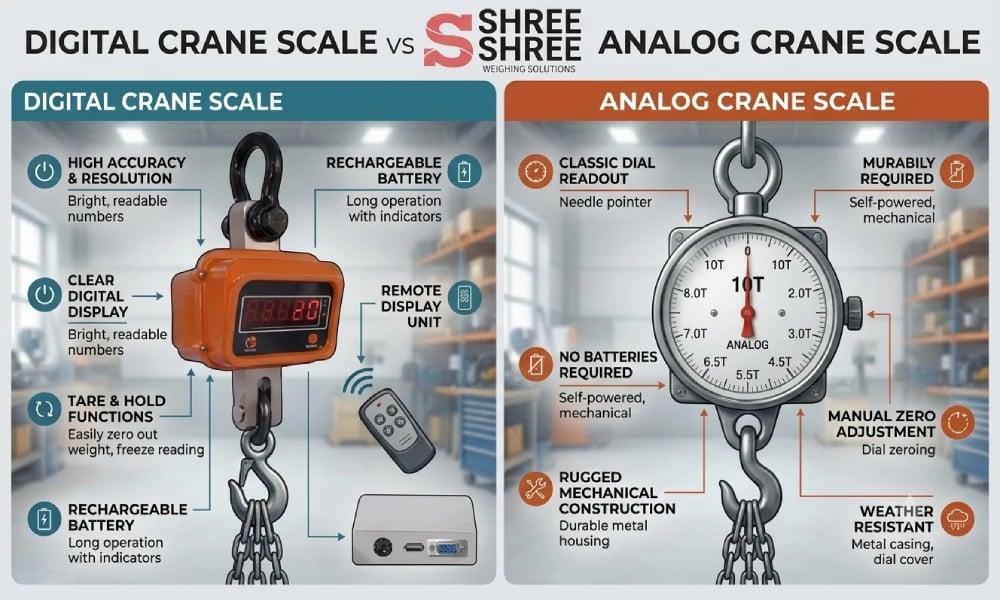
An analog crane scale operates through a mechanical spring system. The load applies force to a spring, the spring deflects by an amount proportional to the load, and that deflection moves a needle across a printed dial face. The heavier the load, the further the needle travels. Reading the weight means looking at where the needle points on the dial an action that requires the reader to be positioned at the right angle, at the right distance, in sufficient light, with a dial that has not drifted from its calibration baseline.
Each of those conditions introduces error. Parallax the visual distortion that occurs when a dial is read from an angle rather than directly face-on alone can account for significant reading inaccuracy on a high-capacity crane scale where each graduation on the dial represents 50 or 100 kilograms. Multiply that by dozens of weighing cycles per shift and the cumulative inaccuracy in recorded weights becomes a real operational problem.
Mechanical spring systems also drift with use. Springs fatigue under repeated loading, particularly when loaded close to capacity or subjected to shock loading when a load is lifted quickly or swings during the weighing process. A spring that has weakened reads lighter than the actual load which is precisely the wrong direction for a safety-critical application. Recalibrating a mechanical spring system requires specialist equipment and access that most industrial facilities do not have on-site.
The documentation problem with analog crane scales is equally significant. Every weight recorded from a dial scale is transcribed by a person, by hand, into a log book or data entry system. That transcription introduces another layer of error and creates a paper trail that is slow, difficult to audit, and impossible to integrate with digital inventory or logistics systems without manual re-entry.
How a Digital Crane Scale Works and What It Changes
A digital crane scale uses a load cell a precision strain gauge transducer as its sensing element rather than a mechanical spring. When a load is applied, the load cell deforms microscopically and the resulting change in electrical resistance is amplified, converted to a digital signal, and displayed as a numerical weight reading on an LED or LCD display. The entire measurement process is electronic, and the result appears on the display as a precise numerical value rather than a needle position that must be interpreted.
Readability and Accuracy That Actually Holds Over Time
The accuracy of a well-specified digital crane scale is typically expressed as a percentage of the full scale reading commonly 0.1% or 0.2% for industrial-grade instruments. On a 5,000 kilogram crane scale with 0.1% accuracy, that represents a maximum error of 5 kilograms across the full capacity range. A comparable analog instrument, factoring in dial graduation size, spring fatigue, and parallax reading error, will rarely achieve anything close to that level of accuracy in real-world industrial conditions.
Load cell technology does not fatigue in the same way that mechanical springs do. A load cell that is operated within its rated capacity maintains its calibration baseline far longer than a mechanical system under comparable use conditions. Recalibration, when it is needed, is carried out electronically using known calibration weights a faster and more verifiable process than mechanical spring adjustment.
Remote Display and Wireless Operation
One of the practical limitations of working with a hanging crane scale in an industrial environment is that the scale is suspended at height, in motion, and often not in an ideal position for the operator to read the display directly. On an analog scale, this problem has no good solution the operator either climbs to read the dial, or estimates from a distance, or relies on a signal from a spotter who can see the needle.
Digital crane scales solve this with remote display options and wireless communication. A wireless receiver paired to the scale transmits the weight reading to a handheld display or a fixed receiver mounted at the operator's eye level, eliminating the need to be physically adjacent to the scale to get an accurate reading. For overhead crane applications, port operations, and any environment where the scale is regularly positioned well above the operator's head, this capability alone represents a significant safety and efficiency improvement.
The Printer Indicator Where Documentation Changes Completely
One of the most operationally significant features available on modern digital crane scales is the integrated printer indicator. When a digital crane scale is connected to a printer indicator, every weighing cycle produces a printed ticket showing the weight, date, time, and any reference number or operator ID entered before the weighing. That ticket is a contemporaneous, machine-generated record that requires no transcription and carries no handwriting errors.
For operations that weigh goods for commercial transactions scrap metal buyers paying by the kilogram, ports billing by cargo weight, paper mills tracking jumbo roll production the printed weight ticket is both an operational record and a legally relevant commercial document. An analog scale can only produce a verbal reading that someone writes down. A digital crane scale with a printer indicator produces a verifiable, auditable record automatically.
The productivity gain from eliminating manual log book entries is consistently underestimated before the switch and immediately obvious after it. An operator who weighs forty loads per shift and manually records each weight is spending a meaningful portion of their shift on documentation. A printer-equipped digital crane scale reduces that to mounting the load, waiting for the stable reading, pressing print, and moving on.
Safety Implications The Argument That Should Close the Debate
Any crane operation involves risk. A load that exceeds the rated capacity of the lifting equipment whether the crane hook, the sling, the shackle, or the crane itself can cause equipment failure, dropped loads, and serious injury or fatality. The weight of the load is the most fundamental piece of information in managing that risk, and the accuracy with which that weight is known determines how safely the operation runs.
An analog crane scale that reads 4,200 kilograms when the actual load is 4,600 kilograms is not just inaccurate it is telling an operator that a load well above the equipment's safe working limit is within safe parameters. That is a safety failure built into the instrument. A digital crane scale with an overload alarm a standard feature on most modern digital instruments alerts the operator immediately when a load approaches or exceeds a pre-set threshold, giving them the opportunity to stop the lift before equipment failure occurs.
The overload alarm feature has no analog equivalent. A needle pointing past the maximum graduation on a dial face does not alert anyone it just records an excessive load passively, assuming the operator is looking at it from the right angle in adequate lighting. The active alert that a digital crane scale provides is a genuine safety function that mechanical instruments simply cannot replicate.
Choosing the Right Digital Crane Scale Manufacturer
The decision to switch from analog to digital is straightforward once the operational case is understood. The more nuanced decision is which digital crane scale to buy and from which source. Not every instrument on the market delivers the accuracy, build quality, and after-sales support that industrial use demands.
A reliable crane scale manufacturer should be able to provide full technical specifications including accuracy class, load cell type and IP rating, operating temperature range, and battery life. They should supply calibration documentation traceable to national measurement standards and should be able to support legal metrology verification for instruments used in commercial trade applications under the Legal Metrology Act of India.
Ask specifically about the wireless range and reliability of any wireless-equipped model a wireless crane scale that loses connection intermittently in a busy industrial RF environment is an unreliable instrument regardless of its static accuracy. Ask about the printer compatibility, ticket format options, and whether the indicator supports data output to a PC or ERP system for digital record integration.
A crane scale supplier who can answer these questions in detail, provide reference sites in similar industries, and support the instrument through its working life is a supplier worth engaging seriously. The lowest-priced digital crane scale on the market is not automatically the best value when total cost of ownership including calibration, maintenance, and replacement parts availability is calculated over five years of industrial use.
The analog crane scale sitting in your yard or warehouse is not just an older instrument it is a daily source of measurement uncertainty, a documentation bottleneck, and a safety system that cannot actively protect against overload. Every one of those limitations has a direct cost, even when the scale appears to be functioning normally.
A digital crane scale with accurate load cell technology, remote display capability, and an integrated printer indicator solves each of those problems at a cost that pays back within the first year of operation for any facility weighing loads regularly. The question is not whether the switch is worth making the case for that is clear. The question is which instrument specification matches your application and which crane scale manufacturer has the technical capability and service infrastructure to support it over the long term.
Map out your application maximum load, lifting environment, documentation requirements, and trade or internal use and use that specification to evaluate suppliers properly. The right digital crane scale, properly specified and sourced from a reputable supplier, will still be delivering accurate, documented, safe weighing results a decade from now.