
Complete Guide to Load Cell Weighing Systems Types, Working Principle, and Applications & How to Choose the Right One
Most industrial operations weigh something. A chemical plant measures batch ingredients. A grain silo tracks inventory levels without opening the vessel. A packaging line monitors fill weight on every unit. A truck scale verifies that vehicles leaving a quarry are within legal load limits. In every one of these scenarios, the accuracy of the measurement rests on a single component that most people in the building have never thought about: the load cell.
6/3/20266 min read
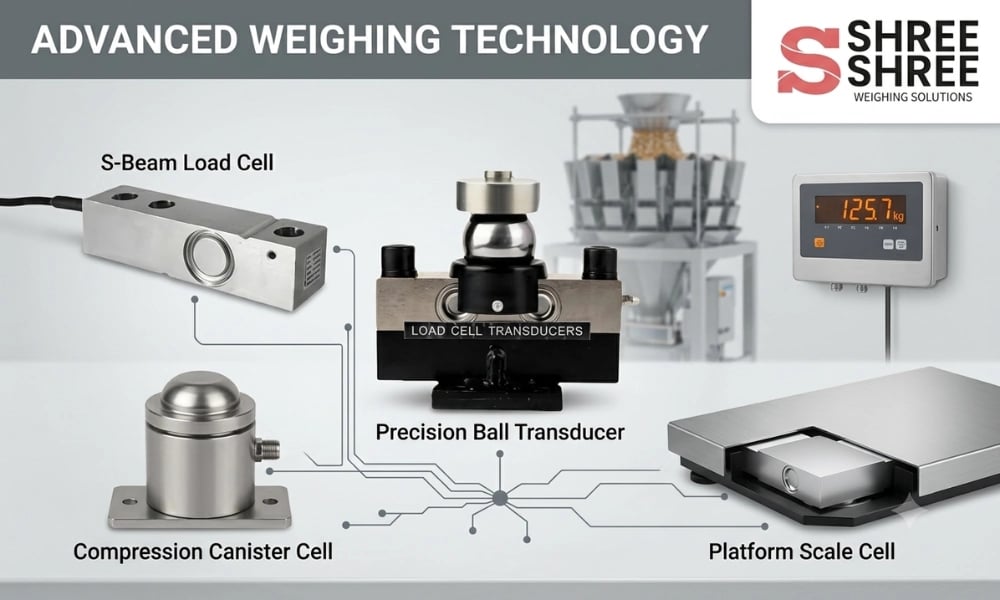
A load cell weighing system is not a single product it is an engineered assembly of sensing elements, structural hardware, signal conditioning electronics, and display or data output equipment, all working together to convert a physical force into a reliable, readable measurement. Understanding how these systems work, which types exist, and what separates a well-specified system from a poorly specified one is knowledge that directly affects operational efficiency, product quality, compliance, and the long-term cost of running your facility.
This guide covers everything a buyer, engineer, or operations manager needs to know before specifying or purchasing a load cell weighing system.
How a Load Cell Actually Works
The load cell is the heart of any precision weighing system. Strip away the display, the software, and the structural framework, and what you have is a transducer a device that converts a mechanical input (force or weight) into an electrical signal that can be measured and interpreted.
The most widely used technology is the strain gauge load cell. A strain gauge is a thin resistive element bonded to a metal body typically alloy steel or stainless steel machined to a specific geometry. When a load is applied to the cell body, the metal deforms very slightly. This deformation stretches or compresses the strain gauges bonded to its surface, changing their electrical resistance in proportion to the applied force. The change in resistance is measured through a Wheatstone bridge circuit and amplified into a millivolt signal that the indicator or controller can interpret as a weight reading.
The engineering precision in this process is remarkable. A well-designed load cell produces a linear, repeatable output signal across its full capacity range meaning the relationship between applied force and output voltage is consistent and predictable from the first measurement to the millionth. This predictability is what makes strain gauge technology the foundation of industrial weighing machine design globally.
Types of Load Cells and When to Use Each
Compression Load Cells
Compression load cells are designed to bear load in the downward direction the load pushes down on the cell, compressing the sensing element. They are the standard choice for platform scales, floor scales, weighbridges, and any application where the weighed object rests on a platform directly above the cell.
The canister load cell a cylindrical compression design is particularly common in heavy industrial applications like truck scales and large platform weighing systems. Its compact geometry allows it to be mounted beneath scale corners in a low-profile configuration, and its high capacity ratings make it suitable for loads from a few hundred kilograms to hundreds of tonnes.
Tension Load Cells and S-Type Load Cells
Tension load cells measure pulling forces rather than compressive ones. The load hangs below the cell, putting the sensing element in tension rather than compression. S-type load cells named for their characteristic S-shaped profile can operate in both tension and compression, making them versatile for applications where the loading direction varies or where space constraints prevent the use of a conventional mounting arrangement.
Crane scales and hanging scales use tension load cells as their primary sensing element. Hopper and tank weighing systems often use tension cells when the vessel is suspended from above rather than sitting on a platform.
Single Point Load Cells
Single point load cells are designed to support an off-centre load while still delivering accurate readings regardless of where on the platform the load is placed. They are the standard choice for compact platform scales, bench scales, and retail weighing applications where the load position on the platform varies with each use.
A single point cell is machined to resist the bending moments created by eccentric loading so even when a load sits at the corner of the platform rather than the centre, the output remains accurate. This makes them practical and cost-effective for small-to-medium capacity applications.
Shear Beam Load Cells
For larger platform scales where a single point cell lacks the capacity needed, shear beam load cells are typically used one at each corner of the weighing platform. The outputs from all four cells are summed through a junction box, and the combined signal is fed to the indicator as a single measurement.
The corner-mounted shear beam configuration is the workhorse arrangement of industrial weighing machine design. It scales from a few hundred kilograms for light industrial platforms to tens of tonnes for heavy-duty floor scales.
Key Applications of Load Cell Weighing Systems
Tank, Hopper and Silo Weighing
One of the most valuable applications of a load cell weighing system is continuous inventory monitoring of storage vessels. By mounting load cells under the support legs or suspension points of a tank or silo, the system measures the total weight of the vessel and its contents continuously. As material is added or removed, the weight change is tracked in real time giving operators accurate inventory data without needing to open the vessel, use level sensors, or rely on manual dipping.
This approach is used extensively in chemical processing, food manufacturing, grain storage, and liquid storage facilities where real-time inventory visibility affects production scheduling, procurement decisions, and safety management.
Conveyor Belt Weighing
A conveyor belt weigher also called a belt scale or in-motion weighing system uses load cells mounted beneath a section of the conveyor belt to measure the weight of material passing over the scale in real time. Combined with a belt speed sensor, the system calculates the flow rate of material kilograms per hour or tonnes per hour and the cumulative total weight transferred.
This type of precision weighing system is used extensively in mining, quarrying, cement manufacturing, grain handling, and any process industry where continuous material flow needs to be monitored and controlled.
Weighbridge and Truck Scale Systems
A weighbridge is a large-scale load cell weighing system designed to measure the gross weight of road vehicles trucks, tankers, and agricultural vehicles with their load. Load cells are installed beneath a steel or concrete deck at ground level. As a vehicle drives onto the deck, the load cells measure the total weight and transmit the reading to an indicator or automated ticketing system.
Legal metrology requirements in most countries mandate that weighbridges used for commercial transactions be verified and certified to national measurement standards. The load cells used in these installations must carry OIML (International Organisation of Legal Metrology) or equivalent national certification.
Process and Batching Systems
In pharmaceutical manufacturing, chemical blending, and food production, load cell systems control the precise addition of ingredients to batches. The vessel sits on load cells, and as each ingredient is added, the weight increase is monitored in real time. When the target weight is reached, the system signals the dosing valve or conveyor to stop.
This closed-loop batch weighing approach delivers ingredient accuracy that manual weighing cannot match at production scale, and it creates a complete digital record of every batch critical for traceability, quality management, and regulatory compliance.
Choosing the Right Load Cell Weighing System
Match Capacity to Application With Margin
The rated capacity of a load cell must exceed the maximum load it will ever be asked to measure and not just by a small margin. Industry practice is to specify load cells at no more than 60–70% of rated capacity under normal operating conditions, leaving headroom for dynamic loading, overloads, and the weight of the platform structure itself.
For a platform scale designed to weigh loads up to 1,000 kilograms, the load cells should be rated for at least 1,500 to 2,000 kilograms. This capacity margin protects the cells from shock loading which occurs when loads are dropped or placed with impact and extends the working life of the sensing elements significantly.
Environmental Protection Rating
The IP (Ingress Protection) rating of a load cell determines its resistance to dust and water ingress. Load cells installed in outdoor environments, food processing areas, or wash-down locations need IP67 or IP68 ratings at minimum meaning they can withstand temporary or continuous submersion in water without damage. Cells installed in clean, dry indoor environments may operate adequately with a lower IP rating, but specifying the highest practical protection level costs little extra and eliminates a common failure mode.
Signal Output and System Integration
A load cell produces a millivolt signal that must be processed by a weight indicator, PLC, or digital controller before it is useful. The compatibility between the load cell's signal output and the indicator's input specification must be confirmed before system assembly. In multi-cell systems, the junction box that combines the signals from individual cells must be matched to the number of cells and their combined output.
For systems that need to integrate with PLC-based automation, SCADA platforms, or enterprise resource planning software, confirm that the indicator supports the required communication protocol whether that is Modbus, Profibus, OPC-UA, or simple digital I/O signals.
Certification Requirements for Trade Use
Any load cell weighing system used in commercial transactions buying or selling goods by weight must comply with legal metrology regulations in the country of use. In India, this means compliance with the Legal Metrology Act and verification by an authorised inspector. The load cells used in trade-approved systems must carry OIML certification. Specifying non-certified cells in a trade application creates legal and financial exposure that no operational cost saving justifies.
A load cell weighing system is not a commodity purchase. The correct specification cell type, capacity, environmental rating, signal configuration, and certification status determines whether the system delivers accurate, reliable measurement for its entire working life or becomes a source of ongoing operational problems and maintenance cost.
The buyers and engineers who understand these systems at a technical level make better purchasing decisions, ask better questions of their suppliers, and end up with installations that perform as expected from day one. Whether the application is a simple bench scale or a fully automated batching system with PLC integration, the principles are the same: specify correctly, verify credentials, and commission carefully.
A well-chosen load cell weighing system earns its cost back quickly. A poorly specified one costs far more than the money saved at the point of purchase.